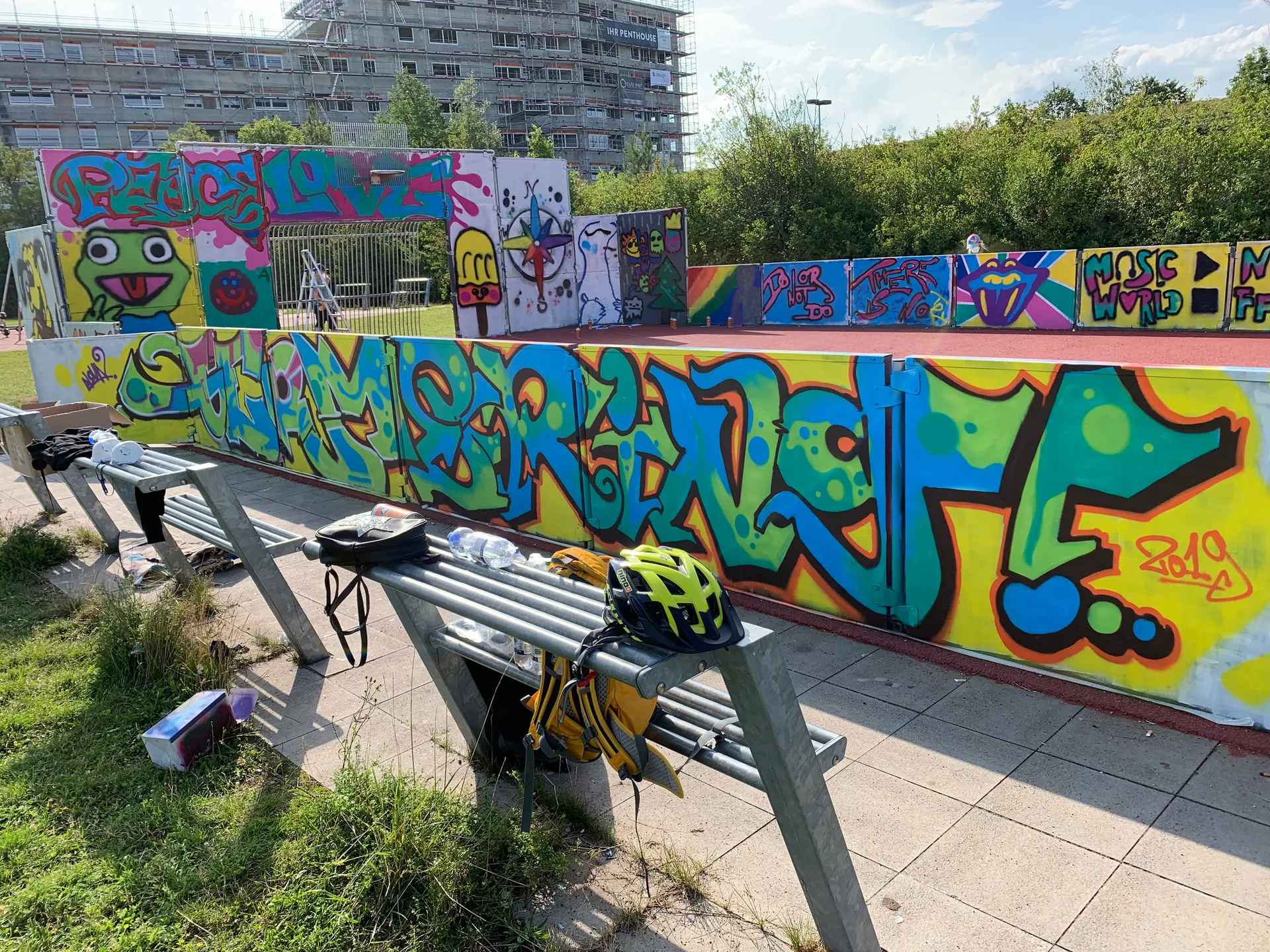
Aloun Phetnoi Ferzandi was eleven years old when he first came across the thing that, in his own words, would later save him: "Without hip-hop I would have ended up sinking into drugs." It helps to know that Ferzandi means more by "hip-hop" than, say, someone who hasn't been active in Munich's scene for more than 20 years. "Spraying, rapping, DJing and breaking - those are the four elements of hip-hop."
For Ferzandi, it only becomes hip-hop culture when graffiti art, rapping, record sampling and breakdance come together. Just rapping, which is what most people mean by the buzzword hip-hop these days, isn't enough for him. Back in the day, he remembers, there were still youth centres in Munich that held so-called hip-hop jams, where all the elements came together. "Places like that don't exist any more." In general, he says, the hip-hop scene has changed a lot over the past decades, in his neighbourhood, in Munich and worldwide. Only the basic principle of hip-hop has always stayed the same: "Creating something out of nothing - that's what hip-hop taught me."
Ferzandi grew up in Hasenbergl. With little money and few prospects. Back then the neighbourhood was an even rougher place than it is today. "We just hung around at the playground, and at some point someone said: 'Let's go into town and nick some wallets.'" So they went into town. That, he says, was his youth. "We didn't have any adults or mentors who'd ever tell us: don't throw your life away."
It almost seems as if Ferzandi wants to take on that role for young people today - for instance when two teenagers are standing outside his dance studio at Weißenseestraße 101. A casual greeting, a bit of small talk - they know each other. Could they just dance for a bit, the two ask. Of course Ferzandi opens his door. But becoming a hub for Munich's up-and-coming hip-hop scene himself is not what he wants: "Others should do that." Ferzandi is now 37 years old and has three young children. His wilder days are behind him.
During the summer holidays, eleven-year-old Ferzandi visited his cousin in Berlin. That's how he discovered graffiti art. After that, nothing else mattered to him, "I was always searching for hip-hop." Maybe also because hip-hop offered something he had only been searching for until then. "The scene, I mean, it's like a family." At Zeugnerhof, a youth centre in Berg am Laim, he finally found hip-hop in Munich, a second home. Again thanks to a piece of graffiti. On a wall of the old farmhouse that had been converted into a youth centre, he saw a piece by Loomit. His thought back then: "Whoa, awesome, this is where you belong." Loomit's real name is Mathias Köhler, and he is regarded as one of Germany's most important graffiti artists, then as now.
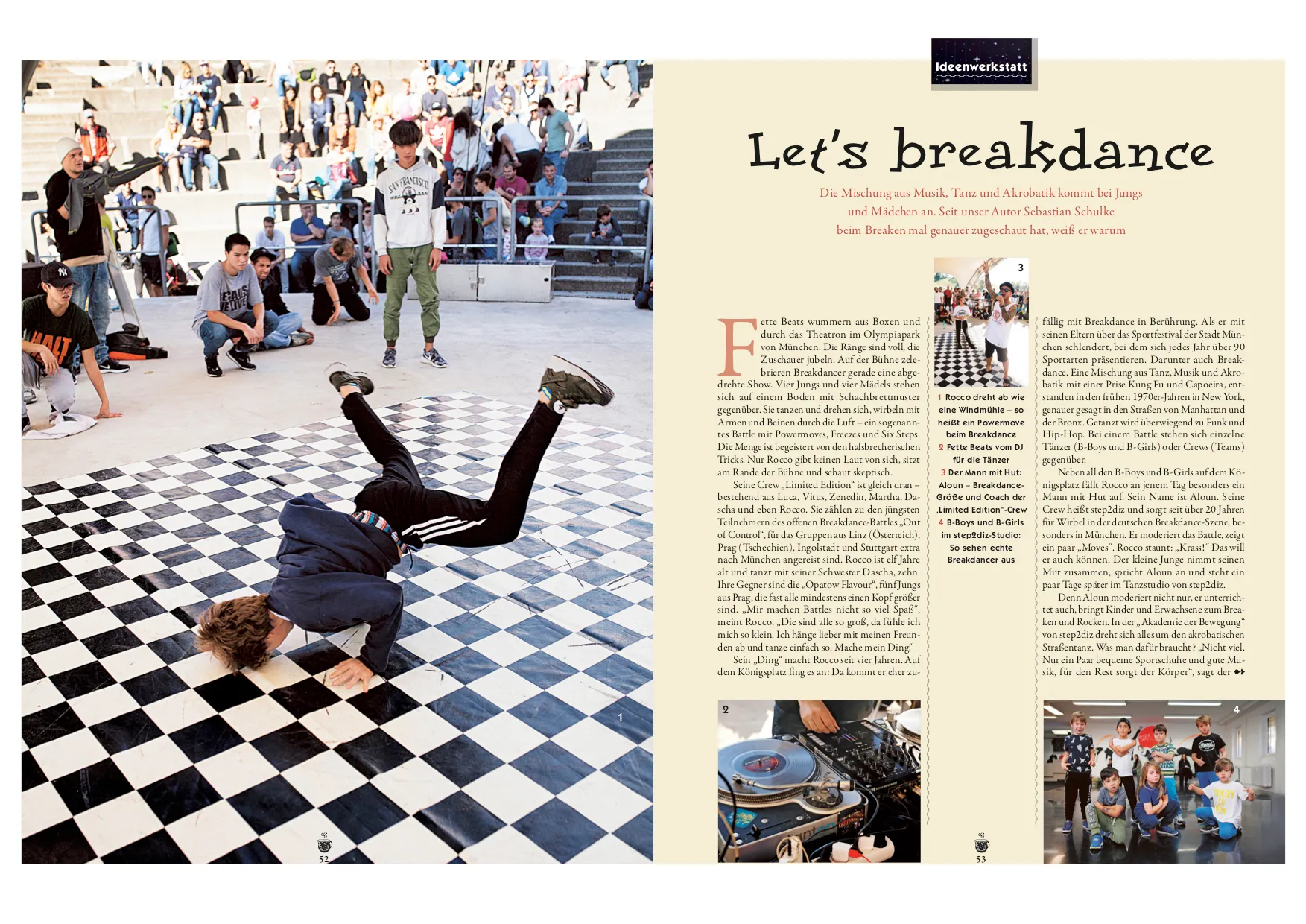
Masters among themselves: the German Breakdance and Electric Boogie Championship took place at the Werner-von-Siemens-Gymnasium.Alessandra Schellnegger
Astrid Weindl, youth leader at Zeugnerhof at the time, remembers the young Ferzandi well. Partly because the two are still in touch today. "Aloun is simply one of my favourites," she says. When the now-retired Weindl talks about Ferzandi, she positively gushes. She knows few people with such human warmth, such a big heart and such sensitivity. "That's what I find fascinating about him".
Whenever a project comes up where she needs support, Ferzandi is on board straight away. With ideas and commitment - as a volunteer. "He doesn't even ask whether he'll get a fee, or how much." There's something like motherly love in Weindl's voice as she tells the story.
An affection that Ferzandi returns. Probably also because it was ultimately thanks to Weindl that he got into breaking, as Weindl recounts with a touch of pride. She introduced him to a group of BBoys - as breakdancers call themselves - who practised regularly at Zeugnerhof. At first Ferzandi was sceptical: "I thought, I'm not flexible at all." He went along to a practice session anyway. Partly because his cousin's words were still ringing in his ears: "You're only a hip-hopper once you know a rapper, a DJ, a sprayer and a breaker." Back then he didn't know a breaker yet. Today he earns his living with this dance style. But before it came to that, he regularly danced street shows on Marienplatz. "From the first Glockenspiel until five in the afternoon." The coins were enough to fund trips to hip-hop jams all over Germany and Europe.
Jams celebrate hip-hop culture and give space to all four elements of hip-hop. Back then, he says, he still "ate the leftovers at McDonald's" or spent the night at the "luggage lockers at the main station". Never mind, as long as it was hip-hop - "always searching", always on the road. Today, he says, young people get their influences from YouTube. "That's totally fine too," says Ferzandi.
But you don't quite believe him. After all, it means losing what matters so much to him about the scene. The sense of family, freestyling - that is, improvising rhymes - on the train to the next jam, simply gets replaced by watching videos alone on the internet.
What began with street shows eventually took Ferzandi onto the cinema screen. As a breakdancing Elvis impersonator in Michael "Bully" Herbig's western comedy "Der Schuh des Manitu". The days of eating leftovers at the nearest fast-food outlet were over. Still, "the commercial side wasn't that interesting", he says. He never had much time for the "world of make-believe". "I always wanted to go to the youth centres." Hip-hop, after all, is really "an underground thing", the street and not the penthouse.
And yet a lot of money is now being made from what was once an underground culture. Above all with the familiar cliché of the gangster rapper, which many artists today, such as the Hamburg group 187 Straßenbande, celebrate and market. But that's no longer Ferzandi's hip-hop. For him, violence, drugs and alcohol are just a modern distortion of hip-hop. "Zulu Nation", the movement within the scene he identifies with, emerged in the 1970s around New York DJ Afrika Bambaataa. While rival gangs in the USA fought each other in bloody street shootouts, the Zulu Nation wanted to settle the conflicts between the gangs elsewhere, for example on the dance floor in breakdance battles. Rivalry, "competition", is part of hip-hop, but it should be peaceful, says Ferzandi. While drug use became a self-fulfilling prophecy of the gangster rap genre, the members of the Zulu Nation reject all drugs. That's why, as a teenager, he wore ski goggles for a while, for example. "Ski goggles against the snow, meaning against the coke."
Over the past ten years, Ferzandi has taken things more calmly. Three years ago his son was born, and two daughters followed. Under the name of his breakdance crew "step2diz" he opened a dance studio in Obergiesing, and recently a second one in Haidhausen. So that he wouldn't be on the road so often; for the children's sake. But in recent years he has actually earned most of his money as a specialist sports teacher at various schools in Munich. Even when he was injured once, he says. When he was due to teach dance to a Year 9 class at a Mittelschule while on crutches, he first heard quiet murmuring among the pupils. "Hey, cripple," one pupil said, Ferzandi remembers. So he threw his crutches on the floor - as he tells the story, he mimics the throwing motion with his hands - and simply spun on his head. The move is called the "helicopter". A "powermove" that impresses, even a class of adolescent teenagers. After that, he says, he directed the lesson sitting down with his crutches. There it is again, the principle that matters so much to Ferzandi. Creating something out of nothing. If need be, even with less than you would actually need. "That's what hip-hop taught me."